Monday, October 1, 2012

KALE, yes!

(You have to say it with a southern accent.)


There isn't much I miss about life in the United States, but kale is definitely one of them. Anyone within shouting distance has heard me lamenting the dearth of this beloved cruciferous green here in l'Hexagone. It's not like I haven't tried to source it, either. I've been to scads of markets and talked to oodles of vendors, half of whom had no idea what the hell I was talking about. "Kale? C'est quoi, ca?" or "Bah, non" were the consistent replies to my sad-eyed queries.

More than a year ago, my friend Nathalie suggested we go to an AMAP (Associations pour le Maintien d'une Agriculture Paysanne) event on Canal de l'Ourcq and talk to actual farmers to see if they'd be willing to consider growing it. One fellow expressed an interest, but only if we had enough people to make it worth his while. He needed a commitment of 30 people, which was about triple the number of people I actually new in the city. I gave up. I figured I could eat collard greens and gai lan--also known as Chinese kale--until I was back in the land of the red, white, and greens.


Back in June, on a trip to London, I picked up two bunches of kale (all I had room for) at a Whole Foods market and ferried them back home on the Eurostar. Reacquainting myself with this this old edible friend only amplified the longing for it; would it be reasonable to consider quitting France simply to gain better access to my beloved vegetable? The kale-obsessed quadrant of my brain said "oui."

Then, nearly without warning, un petit miracle: My friend and fellow expat Karin introduced me to Kristen, another kale-loving American. The difference between my love of kale and Kristen's is that this girl didn't just whinge about the no-kale situation; she actually embarked on a no-stopping-until-success mission she dubbed The Kale Project to bring the damn stuff to France. In September, her efforts made so many wishful thinkers' dreams come true: She got the farmers to grow it, and now it's being sold at a few outdoor markets in gay, gay Paree. Hallelujah! Praise Kristen!


Kale had its coming-out party at Verjus, a lovely little restaurant owned by a pair of (yep, you guessed it) expat Americans. The restaurant is the current darling of the Parisian "modern French" dining scene, and I'd wanted to check it out ever since discovering they'll do a vegan menu with a bit of advance warning. I gave absolutely no advance warning when I showed up asking for something kale-ish and vegan. (If you assumed, wrongly, as I did, that a kale menu implied there would already be something vegan, you would have been, as I was, saddened to discover otherwise.) The good news was that the wonderful chef busted out an impromptu kale gaspacho that totally exceeded my taste-bud's expectations. You really can't go wrong when you mix kale with heirloom tomatoes, smoked almonds, fennel, and onions.


A freelance reporter for the New York Times turned up for the event, as did a lot of pretty, blonde young things who look like they'd gone a long time without eating kale--or any other kind of food. But the star of the show was definitely Kristen, the kale messiah of the vegetable-loving Parisian masses. Where will I be this Sunday? At "church," otherwise known as the outdoor market, giving thanks for kale.

Monday, August 13, 2012

Chocolate Bliss

The source of Micah's smile? I'm guessing it's his magical chocolates.

I'd have eaten the whole tray if I wasn't in civilized company. 
One of the best things about being a writer is the inevitable learning process that each new assignment becomes. You can't help but absorb information and expand your horizons when you're researching and writing about new things. Take chocolate, for instance.

OK: I already knew a thing or two about chocolate. Mostly, that I like the way it tastes. In France, there is no shortage of dark chocolate for vegans to indulge in, so I do it regularly (as in every single day). And with the opening of Un Monde Vegan, I even have access to white chocolate, and non-dairy-milk chocolate. C'est magnifique. But I digress.

Last month I was invited to attend a chocolate-making class by a visiting American and fellow vegan who would be teaching three workshops in Europe. Two of them happened to be in Paris, and while I didn't have a specific story in mind for this experience, I figured I'd come up with something. (I eventually did.)

One of a few "super" ingredients that give these chocolates that
extra  special something.

It's hard to let go when the chocolate tastes this good.

Micah and fellow raw chocalatier Frederic Marr turn on the handsome,
just like that.

On a balmy July afternoon I cycled across town to ChocoLatitudes, a new-to-me chocolate boutique on a quiet street tucked between Montparnasse Tower and Montparnasse cemetery. I arrived just in time for introductions; there were approximately 10 of us, an equal mix of Anglophones, Francophones, and one Italian to round things out. Initially, I sat myself at the back, thinking that since I was here to observe and report, I wouldn't need to be in the thick of the action. Laurence, ChocoLatitudes' owner, thought otherwise, and positioned me in a front-row-center sort of spot, with awesome views of the chocolate yumminess and the choco-maestro himself, Micah Intrator.


Enter ChocoLatitudes if you dare to be tempted by chocoholicism.

One of many vegan treats that await at ChocoLatitudes.

Laurence, fellow vegan and ChocoLatitudes' lovely owner.
Micah began dabbling in chocolate-making several years ago, mostly as an experiment. He wanted to package all the goodness of the superfood smoothies he made for himself each morning into a compact, portable form that would allow him easy access to sustained energy throughout the day. Turns out chocolate was the perfect vehicle. Today, he makes exquisite confections and sells them at artisan shops in and around his hometown of Chapel Hill, NC.

I won't stop staring until you let us taste.
How long until those are ready?

Throughout the two-hour class, Micah tutored us in the fine art of chocolatiering, making it look easy, fun, and kinda cool--in spite of the goji berries. Using interesting and unfamiliar  (to me) ingredients such as maca, mesquite, and lucuma, he created some of the best-tasting stuff I've ever had the joy of devouring. As a "reporter," I hadn't anticipated active participation, but all professionalism fell by the wayside when the samples started making their way around the room.

With the first taste, I morphed into ChocoMonster.  Hadn''t Neal Barnard written in one of his books that chocolate (like cheese) has opioid properties that mimic the same intoxicating feeling you get from heroin? This chocolate was so intense I could practically feel the opioids rolling around in my mouth. Especially in the Chocolate Caramel Crunch bars. Heaven on a stick. (Without the stick.)


The Italian contingency sampling the secret ingredients.

Stepping out into the street after the workshop, I had the sensation of soaring on a chocolate-covered cloud--one from which I hoped never to descend. I finally did, though, hours later. And since then, I've been dreaming about those chocolates, and remembering that chocolate high with a bittersweetness matched only by the dark, chocolately goodness of those magical confections.

Wednesday, August 8, 2012

Wine, Women, and Song

A cafe in the tiny village of Plazac, France. On the menu: vegan gaspacho, an assiette vegetarienne (vegetarian plate), fruit smoothies, and Tibetan momo. Not your average French cafe, in other words.
I met Jachi at Pine Hill Waldorf School in Wilton, New Hampshire, when we were both in the 6th grade and I was the new kid in class. My dad was the janitor there, and later at High Mowing Waldorf School, in exchange for tuition for me and my brother. For a self-conscious pre-teen trying to fit in, this was a never-ending source of shame and embarrassment.

Jachi didn't mind that, nor did she seem to mind hanging out from time to time in our funky cabin in the woods, where our main water supply was generated from an old-school hand-pump, the bathroom was an outhouse, and all our meals were prepared on a wood-burning stove. Jachi was special in that uniquely non-judgmental way, and on many other levels: She was a talented violinist, a sophisticated world traveler, and she possessed a precocious spiritual maturity for an adolescent (she meditated daily!).


Flowers in the French garden Jachi's mother planted and continues to nurture
My favorite memories from that period were sleepovers at Jachi's family's home on Curtis Farm Road, surrounded by apple trees and rolling green hills. She even had her own horse, and on weekends when I stayed the night, I'd help scoop poop in the barn, and occasionally take the horse for a quick ride.

One of our fellow classmates and Jachi's neighbor down the road was Julianna Margulies (she was a year ahead of us in school), and I can still remember the day we walked to her house to deliver get-well greetings when Julianna was sick with the flu. Her  mother, a pre-Raphaelite beauty with long raven ringlets, served us grapefruit halves sprinkled with turbinado sugar, which we ate with special serrated spoons. It was a magic moment! (Even then, Julianna had star quality, and looked like Sleeping Beauty when we sat at her bedside.)

A village scene, avec velo, wisteria, and wine barrel

When my family left New Hampshire to return to California, I lost touch with Jachi, who continued her Waldorf education before heading off to Sarah Lawrence, then Yale, while I graduated from high school then became a vagabond  in Hawaii and Los Angeles before finally settling down for the long haul in San Francisco. Our trajectories were similar, yet different; she attended good schools, studying literature, creative writing, and finally music (the violin, still), while I went to a public schools and studied writing (journalism) and finally entered a graduate program in English literature.

On the road in the Dordogne Valley
Skipping ahead many, many years, Jachi and I reconnected from our respective homes in Brooklyn and San Francisco, never supposing our actual paths might cross again in an unexpected place: France!

Jachi met her husband at a Buddhist retreat in the south of France, in a little town in the Dordogne Valley, and after several years of the fast-paced life in the Big Apple, they decided to chuck it all in and move to his native France. On her way back to New York to put her apartment on the market, she passed through Paris, and we arranged a coffee rendezvous at Gare d'Austerlitz which stretched into a multi-hour middle-school reunion at a nearby brasserie. It was a great feeling to reconnect with an important person from my past, and such a surprise to discover a sense of connection. You never know if you'll have that, but we did.

My temporary home in Plazac sat at the end of this slender footpath
Recently, I received a phone call from my dear friend with an invitation attached: Would I like to attend her first live violin performance in France--in a private chateau!--the following week down in the Dordogne? Why, yes, I would! On a warm and bright July afternoon, I hopped a train down to Les Eyzies, where I was greeted by Jachi's husband. After being deposited at my temporary accommodations in the tiny village of Plazac, I freshened up and met my roommates--Jachi's friends from New York via Italy. Together, we shared a late lunch of bread, wine, and fresh tomatoes, then set off for the chateau ensemble.

One of my temporary roommates--and a bowlful of juicy heirloom tomatoes season with fresh basil
Jachi and her pianist Luba dazzled us with Beethoven, Franck, and Kreisler, each sonata more beautiful than the next. In between and afterward, we drank Champagne and socialized, and I thanked my lucky stars for the chance to experience something so special in a fairytale setting, surrounded by interesting people. Later, we met at a restaurant where 15 of us dined at a big table on the terrace, eating pizza and sipping Italian wines. It was magic.  

The Chateau du Peuch looks much the same today as it does in this vintage photograph.
From the chateau's front steps looking out over the valley and nearby hills.
Twenty-four hours later, I was back at my Paris apartment, savoring the memory of the experience, the spell not yet broken.

Is there any more perfect place for a reunion than an ancient stone house in the South of France?

Tuesday, July 31, 2012

Step Away From the Speculoos

I got a new regular-ish freelance writing gig and one of my first assignments was to pen a few "accidentally vegan" pieces. I proposed a few potential items, Speculoos spread among them. The stuff has a sort of cult following among Euro-savvy vegans, and I'd always wanted to try it. The ingredients are roughly 60 percent Speculoos cookies (the toast-colored kind you get at cafes and on airplanes that have a subtle cinnamony-ness to them), and the remaining 40 percent is stuff you wish you didn't know about, like oil and sugar.

Looks innocuous enough, right?
I should have known better than to think I could have "just one little taste." It took me all of five days to polish of the entire jar. All by myself. Spoonful by itty-bitty spoonful.

Going in for the kill. 
The aftermath. Deadly!
My next "accidentally vegan" review will be researched and written the old-fashioned way: using first-hand reporting methods that include interviewing people who've tried the product rather than indulging myself. That, or I'm going to have to start reviewing things like carrots and water.

Saturday, July 14, 2012

The People You Meet

Terresa is a fan of natural wines, and thanks to her, I am, too!
A few months ago, I received a surprise email from Terresa Murphy, who runs La Cucina di Terresa, a vegetarian cooking school and catering company she operates from her impossibly adorable and compact apartment in the onzieme. How would I like to come over and have a chat? I'd never actually met Terresa, but had interviewed her for a couple of different food-oriented stories I'd written since moving to Paris. Intrigued, and always keen to meet new and interesting people, I wasted no time responding with an enthusiastic "oui."

Terresa whipping up polenta in her perfectly adorable kitchen
I arrived soaking wet and likely looking a bit disheveled, having crossed the city by bike and riding straight into an unexpected rainstorm. (It was just cloudy when I set off.) Yet Terresa welcomed me like an old friend, making me feel right at home with both her warm and engaging personality, and her incredible food. While we sat talking and getting to know each other, she would occasionally disappear into her kitchen and return with a plate of Italian-themed goodies like savory bruschetta or the mysterious and delicious castanaccio (chestnut-flour cake). Besides a mutual love of plant-based cuisine, we discovered we shared some other similarities,including having lived in San Francisco for large chunks of our lives, and having family who live in Grass Valley.

Not-so-stealthy (and not so good) photo of the Japanese designer's duds (and a runway model in the background)
Terresa at work, slicing her fresh chard pasta (yes, chard!) into perfect diamond shapes
Since that initial tete-a-tete, Terresa has welcomed me back into her home for a festive dinner party where four of us American girls ate like Italian principessas and sipped an array of tasty natural wines. A few weeks ago, Terresa even offered me a two-day gig helping her prepare lunch and dinner for a Japanese design house during fashion week. (The designer and his team were too busy casting models for the runway show to make time for food prep.) Last week, Terresa celebrated a milestone birthday and planned to have her potluck fete in a public garden near her home, but the damn weather got in the way again, forcing the event indoors.

We arrived at her apartment late (a flat tire impeded an on-time arrival) and wet (another unexpected rain storm), and were greeted by a small group of revelers, including culinary superstar David Lebovitz (so nice, so NOT a diva!), his partner Romain (who I refer to as the French Dan Piraro, since they share a certain physical je-ne-sais-quoi) and the charming, gorgeous Kiwi singer/songwriter/veg cookbook author Flip Grater. It was an honor to toast my new friend on her birthday with this charming group of creative, interesting, and welcoming people.

David and Flip: not a comedy act, but a talented pair of expat Parisians
Joyeux Anniversaire, chere Terresa!
Terrea's birthday pasta, brimming with veggies, nuts, and superb olive oil
"The French Dan Piraro" and Co.
Today is Bastille Day (aka La Fete Nationale). And while national pride isn't really mon truc, I'm headed off to the Champ de Mars to join Jeff and the Fat Tire crew for a bit socializing beneath a blanket of suspiciously moist-looking clouds, knowing full well I'm likely to get rained on as I have every other excursion this week. Why bother? Because each outing--whatever the weather--is an opportunity to meet another fascinating person, to delve into each other's histories over a plate of delicious food, and to reinvigorate my love for this beautiful and inspiring city I call home.

Monday, April 23, 2012

Joyce Maynard's Hair

What I knew about Joyce Maynard before going to see her speak at the American Library in Paris, was, frankly, not a whole lot. I knew she was a writer, and I vaguely remembered reading something about her living in Keene, New Hampshire--not far from where I once lived during 6th, 7th, and 8th grade. I'd also read that, back in the '70s, she was the teenage paramour of J.D. Salinger, and it was that titillating tidbit that wrenched me out of my warm apartment and across town to the 7e on a brisk Paris evening.

The book that catapulted Maynard into the spotlight at 17. J'adore that bob

Miss Maynard charmed me immediately. She has an unassuming je ne sais quoi about her; a combination, I think, of a pixieish face that belies her 50-some-odd years, a slightly nervous energy (one that I understand from experience), and a seemingly natural talent for engaging storytelling. She mesmerized the audience--an attentive room-full of plastic-wine-cup-clutching bibliophiles wedged into sturdy Danish Modern chairs--with a riveting recount of the day's drama at the Musee d'Orsay. There, beside a bridge linking the left bank to the right, a team of gypsy pickpockets relieved her of her wallet using that Oh-Here's-The-Ring-You-Dropped scam. The combination of pity, anger, and laughter that her story provoked totally won me over.

The remainder of the evening was no less confessional, and equally spellbinding; with disarming earnestness, Maynard shared intimate details of her topsy-turvy life with us strangers. This was an oral autobiography punctuated with dramatic bullet points--alcoholic parents, an affair with a famous (and bitter, and controlling) old man--and  equally interesting but more mundane details about her development as a writer, parenting, collapsing relationships, and travel. We had a bit in common, I thought.

I left the event empty handed (the book I was most interested in had sold out already), but felt full with that warm-and-fuzzy feeling you get when you realize you're not alone in the universe--that there are kindred spirits within our own orbit who share similar experiences and express those similarities with vivid language.

What was I thinking? A yearlong experiment in blondness that lasted roughly 364 days longer than it should have

Since then, I've followed Mlle. Maynard through the usual social networks, which is where I came upon her most recent piece, this published in the New York Times on April 9 titled "The Kindest Cut." It's about hair. Most of us have at least a little bit of the stuff, and some of us struggle with it on a daily basis: Taming unruly cowlicks, dominating subordinate gray strands with "natural" hair dye, and aiming for a style that doesn't look like you tried too hard or cared too little. It's exhausting work, and has been an all-consuming preoccupation more than a few times in my life.

Right now, I'm preoccupied with whether or not to whack my hair off. I've been growing it long for about two years now, and it hits my upper back right about at bra-strap level
. I think I thought that having long hair again would make me feel pretty. I realize I've never felt pretty, long hair or short, so that's not really a valid reason to schlep around a tangled mess of boring brown tresses. Perhaps, subconsciously, I also harbor a fear that men will no longer find me attractive if I snip of a few inches.


My hair last week. It doesn't look too bad when freshly washed, but it's still time for a change


"Men don't like short hair," a friend tells Maynard knowingly in "The Kindest Cut."  Maynard isn't deterred. "Should my hairstyle be dictated by the desire to please men or myself?" she asks herself in response. Now, I have to ask myself that same question. I hope I'll be brave enough to heed the desire to please myself, and not feel resigned to sporting a head of hair that's boring and unflattering. 


On our way to Copenhagen a couple of weeks ago, I made a pre-flight pit-stop at the Relay store at Charles de Gaulle. Quickly rifling through the magazines, I spotted a fashion feature showing magazine editors (aka "real people") wearing the latest designer duds. The clothes weren't nearly as compelling as one of the editor's hairdos. I hadn't seen anything so fun and interesting in a long time. Her slightly messy, long bob hit about shoulder length, with eye-grazing blond-and-brown bangs funking it up in a mod way. I loved it, and thought, "I wish I could have hair like that."
So, why not? 


Sunday, April 15, 2012

Bye-Bye Bling Bling?

I didn't recognize the man who approached me as I left the chaotic Sunday market on Boulevard Ney. Reaching out with a friendly "bonjour," he pressed a thick pamphlet into my hand as I passed. Looking down at the sober red, white, and blue sheaf, I quickly sized it up as pro-Sarkozy election propaganda. (The public markets, brimming as they always are with Parisians of every political leaning, prove to be prime territories for leafleting.)

At home, after stuffing the last of the spring fava beans and juicy tangerines into our Lilliput-proportioned refrigerator, I flipped open the 34-page manifesto, hoping to discover just how well those twice-weekly french lessons are paying off (suprisingly well), and more so, to learn what the incumbent everyone loves to hate had to say to his public in what are likely the final hours of his tenure. It was a fascinating read.

The president of the Fifth Republic is definitely preoccupied with a few specific themes: immigration, national security, and France's economic strength. Nothing surprising there. More interesting was the thread that held this manifesto together: What it means to be French.

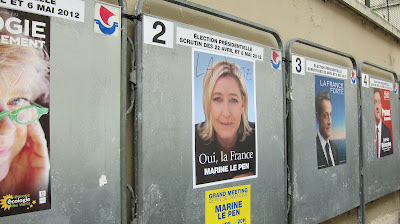
Candidates on every corner: These ubiquitous posters depict the 10 presidential contenders; Ultra right-winger Marine Le Pen's head is scribbled with "Disgrace."

So, what does it mean to be French? In Sarko's view, it means assimilation, and definitely means speaking French, but it's more than that, he says. "Everyone who wants to come to and live in France, whether man or woman, must know that here, we have rules that we impose on everyone: Separation of church and state, a burqa ban in public places, a veil ban for public service workers, mandatory education, equality between men and women, the right of women to work, and an absolute ban on polygamy and female genital mutilation."


He continues (rather snarkily, if you ask me), "In France, men and women use the public pool at the same time. Doctors are both men and women. And school lunch menus are what they are, so don't try to impose your cultural or religious preferences on secular France." (He didn't actually say that last bit, but it was implied. He's made it clear he does not support Islamification on any level, nor does he believe in vegetarian lunch options in public schools.)

"No one is obliged to come to France, after all."

Sarko's plan for the future of France includes reducing new immigration by 50 percent, and then, giving priority to political refugees and highly skilled labor. I wonder what this means for me and the rest of France's current immigrant population? The cynic in me says those immigrants with the whitest skin will find themselves more or less immune to the threat of closing doors and invitations to return "home."

Get out the (youth) vote: Pro-Hollande event flyer posted outside Lycee Honore de Balzac in the 17e

The candidate I believe has the strongest chance of defeating Sarko is Francois Hollande. An unapologetic Socialist, he seems less focused on blaming immigrants for France's problems, which makes him a strong candidate among the
populaire proletariat, and he's one of just a handful of candidates I've seen grooming the youth vote. His campaign buzzword is "change," and where I see that most is in his environmental agenda, which includes reducing reliance on nuclear power, developing renewable energy sources, and reducing greenhouse gas emissions. No word from the Hollande camp on whether that plan includes a moratorium on factory farms, but it could happen! And in typical Socialist fashion, he wants to raise taxes for the rich and redistribute the wealth to bolster public services that will help the neediest in every corner of l'Hexagone. Even if I'm not entitled to vote, these are ideals I can stand behind.

The primary election is this upcoming Sunday. Yes, Sunday! Why vote on a Sunday, instead of, say, a Tuesday? So that everyone can vote. (Well, almost everyone.) Two weeks later, the last two candidates standing will be whittled down to one winner. Is France ready to say au revoir to President Bling Bling? I think the answer is "oui."